I gotta tell you, there is nothing like a cold, rainy day on the range, and I don't mean that in a good way! Yesterday's temps hovered in the low 40s and high 30s; it was raining when I got up at 4:45AM and still raining when I collapsed into bed Sunday evening. It's still raining this morning...I am considering loading Newt and the other pets into an ark.
Still, the Boulder Project Appleseed was a wonderful —
and uplifting — event. That particular Appleseed is a relatively small event, less than a dozen people, because of the size of the range. The bigger Colorado Project Appleseeds are at the larger ranges like Colorado Rifle Club.
Saturday, which was beautiful, was in essence a training day, getting everybody on the same page with the positional shooting (standing/kneeling/sitting/prone), the sling and the Appleseed 6 steps to firing the shot (sight alignment, sight picture, respiratory pause, focus, trigger squeeze and follow through). Here's a shocker…you spend a day shooting groups. As I've said repeatedly on the podcast over the years, shooting groups is one of those fundamental activities for all the shooting sports. Groups tell you whether what you're doing as a shooter is working or not.
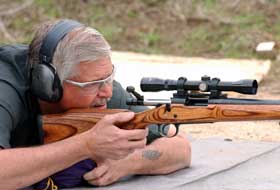
Here's my soaking wet
JP Rifles GMR-13 9mm carbine. Note how I am carefully protecting the
Leupold AR MOD 1.5-4X scope with an equally soaking wet
towel, no doubt the mark of a true professional!
I ran both Glock 17 and Glock 26 magazines during the event, because I am a gamey so-and-so. Appleseeds are shot at 25 yards. There are 2 stages on the AQT "test" that involve reloads. The first is a standing to sitting transition. You prepare 2 magazines, one with 2 rounds, the other with 8. On the "fire" command, you drop to a sitting position, load the rifle, fire 2 shots on your left-hand target (which @ 25 yards simulated a standard human-sized silhouette 2 200 yards, second row of targets, below), then reload and fire 3 shots into the left target, 5 into the right. You have 55 seconds to complete the exercise. I loaded the G26 mag with 2, the G17 mag with 8 so I wouldn't confuse mags. The shorter mags are easier to slam into the magazine, especially considering the rain and how wet everything was. Had I bought 2 G26 mags I might have gone that route.

The other reload stage is same on the magazines, but drop from standing to prone, with 3 targets sized to simulate 300 yard silhouettes (third row down). The shooting sequence is 3-3-4.
As far as other gear, I used a
RifleCraft RS-1 sling. It worked so well that the Appleseed instructors were fondling it after the event. Ammo was
Wilson Signature Match 9mm 125-gr ammo, which uses the
Hornady Action Pistol bullet at 1075 fps. This load is so accurate I plan to build my match reloads around the HAP bullet and see if I can get close to those results. The mat's from
Midway, BTW.
The greatest thing about an Appleseed is the instructors are so darn good. Essentially, we worked on finer and finer points, trying to eliminate the so-very-many "short cuts" that open out groups. Much of Saturday's practice runs were on 1-inch square targets, which are not particularly forgiving. They do, however, allow you to see what you're doing wrong. With my recent fascination for long-distance shooting, these kinds of drills are critical to keep drilling down and refining skills.
SOME OBSERVATIONS:
• The RifleCraft along helped tremendously because it's so simple to use. It is similar in design from
Andy's Leather Rhodesian sling or the
Glaco Safari Ching sling, both of which I've used extensively, in that there's a preformed adjustable loop at the front of the sling. Unlike a
Ching sling, all these slings are 2-pointers. It's easy to slip the RifleCraft loop on your upper support biceps and cinch it down, even over several layers of clothing and rain gear. A sling won't make you a great shooter, but it will give you options. I used a Magpul sling set up with a front loop in the last carbine match I shot. It was much appreciated on the 50 yard head shots!
• I think working with a sling on my standing position has helped me a great deal, mostly because the sling forces you into a good standing position with the support elbow under the gun and the support hand not gripping tightly. Will this standing position work for all situations? Of course not, but it gives you a starting point for exploration. My standing stage (10 rounds in 2 minutes on a simulated 100 yard silhouette) groups steadily tightened up, not to mention the fact that 2 minutes is all the time in the world.
• I think I need to spend a lot more time pondering "rifleman's cadence," meaning that after you've establish your natural point of aim (critical in Appleseed teaching), you can fire an aimed shot at the bottom of each exhale. This works amazingly well...I think it's about teaching yourself how to fire the rifle (much like quickly establishing a natural point of aim). I did a 20-second standing to sitting run, including the reload, and only dropped a few points. Of the 5 shots on the second target, 4 were in the same hole, with the fifth about an inch out.
•
"Aim small; miss small"...hey, it worked for Mel Gibson and Bradley Cooper, it'll work for you! My focus was on shooting one-hole groups in the center, not just hitting the target.
• In the crappy gray weather, the Leupold's adjustable green "FireDot" was invaluable. I kept it dialed down to a minimum, but it helped me focus very specifically on the crosshairs with the glowing green dot in the middle. In those conditions, I like green a lot more than red. In terms of magnification, I shot the standing and the sitting at 1.5X, 3X on the stand to prone stage, and 4X on the prone. The prone, which is shot on 4 simulated 400 yard targets, allows 5 minutes for a string of 10 shots, 2-2-3-3. Since that stage counts double, there is
no excuse not to take the time and get the hits. When I shot the Appleseed with a rimfire a couple of years back for SHOOTING GALLERY, I dialed the 3-9X scope to 9x on the prone and shot groups inside each target.
• Some shooters discovered that "waterproof and fog-proof" scopes were only waterproof if you didn't get them wet and, if you did, they fogged up like summer evenings in San Francisco. This is what you might call a detriment to accuracy. The Leupold had no problems at all.
• Let me offer you a couple of resources that really helped me. The first is
BECOMING A RIFLEMAN, which will get you up to speed on the various positions. The second is the
ART OF THE RIFLE blog, now on a hiatus. This blog has been amazing in analyzing the various aspects of rifle shooting, and I strongly encourage you to read the whole thing. I would also be remiss not to mention Col. Jeff Cooper's
THE ART OF THE RIFLE book, a classic in its own right.
• I think I pretty much dispelled the idea that 9mm carbines won't deliver the goods. To qualify for a "Rifleman" patch, you need to shoot a score of 210 out of a possible 250 points. When I qualified for my first "Rifleman" patch, I eked out 211points with my .22 Spike's/JP AR. With the JP 9mm, my first "trial run" on the AQT target was a 218; on the 2 scoring runs I shot a 222 and a 212, gaining my second "Rifleman" patch. From prone I could consistently shoot one-hole groups in the 1-inch squares at 25 yards.
• Next for me? Some friends are planning to shoot an Appleseed later this summer, and I think I'll join them, this time with my trusty FAL. That ought to give the ole shoulder a workout! At least it's not a G3!
• I love the stories of the American Revolution. They are stories I grew up with and have now fallen into the Memory Hole. With our country coming apart at the seams, I think it's important for all of us to look to the past, to the Founders and their sacrifices, for our inspiration and for our hope. Project Appleseed is, to me, of critical importance because it brings those stories to not only a whole generation who've never heard them, but back to the forefront of our minds as well. And maybe, just maybe, we'll hear the hoof-beats...
For, borne on the night-wind of the Past,
Through all our history, to the last,
In the hour of darkness and peril and need,
The people will waken and listen to hear
The hurrying hoof-beats of that steed,
And the midnight message of Paul Revere.
Here's the
FAQ or Project Appleseed. I cannot recommend it strongly enough.