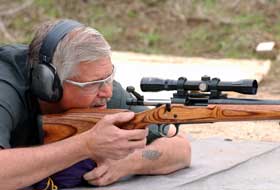
I've been thinking lately about
that ole debil "task loading," or,
why multitasking is a myth. What got me started on this was an interesting thing that happened while I was at
Gunsite. I was on my gazillionth run at the
Scramble course, and we were down to filming the "
cutaways," breaking each shooting position down into its component parts and filming them to allow the editors something to "cut away" to...
movie magic blah blah stuff, doncha know.
Erik Olds, the Gunsite instructor, said, "Your finger's going in the trigger guard before you're in position to shoot."
Happened twice. That's not something I normally
ever do. I mean, I've shot
several hundred matches over the last 30 years — handgun, rifle, shotgun, three-gun, cowboy, submachinegun,
fill-in-the-blank — run high-speed simulations and helped hammer out safety issues for matches years and years ago. If you were to ask me, I'd say I have completely
internalized trigger discipline. Rule 3: Don't put your finger on the trigger until you're ready for the gun to go bang. I didn't touch the trigger, but I was going into the trigger guard too soon.
I realized that task loading had reared its ugly head!The "rule" of task loading states simply that the
more tasks you're asked to perform, the less likely you are to perform all tasks well. Task loading appears
(to me) to follow a
geometric rather than an
arithmatic progression. Imagine a graph where the horizontal axis is
"numbers of tasks" and the vertical axis is an inverse
"quality of performance;" that is, where the vertical axis meets the horizontal axis is
"100% performance," a.k.a. perfect performance. The higher you go on the vertical axis, the worse your performance per task gets.
An arithmatic progression would yield a
straight line whose steepness would be relative how much performance-per-task degraded as additional tasks were added. A geometric progression is a
up-turning curve, with performance-per task drastically declining as additional tasks are added. My observation of and experience with task loading both in firearms instruction and instruction for high-risk sports such as technical diving or climbing Big Mountains is that not only does it follow a geometric progression, but there is a
"crash point," where basically everything goes to hell and you can't do anything...
very bad in a risky situation!Cave divers are real big on task loading, sensitive to even small tasks that are
"no problemo" when taken individually but which add to the overall load. My cave diving instructor was big on the idea that the
complexity of the tasks added didn't really make that much difference — a simple task was every bit as big a load as a compex task. It was the additive nature that made task loading so dangerous.
So why am I harping on this? Because it's not something we normally think about and it's sneaky as hell. Task loading goes against our
common sense, which tells us that several small, non-complex tasks taken as a group should not be a big issue. Then we drive our SUV into a tree we've driven past safely a thousand times.
Here's my example of task loading — I run into the frame, assuming
exactly the same shooting position as when I was running the course for real. Making sure my hands and the gun are in the same position, I take —
and make — the shot, then exit the frame the same way I did it for real. Oh yeah, there are two cameramen in awkward positions I have to make sure I don't sweep when I exit while keeping the muzzle downrange...etc.
John Shaw, who founded the
Mid-South Institute for Self-Defense Shooting, had the best analogy I've ever heard about task loading (although he didn't use it in that context). Imagine, John said, that everyone gets $1 worth —
100 pennies — of concentration. That's it. Nobody gets a buck and a quarter; no matter how many Tony Robbins' seminars you attend, you've still only got those 100 pennies of concentration. Your
only option is how to spend those pennies.
John goes on to talk about focus, but the analogy works perfect for task loading. Every task requires a few pennies — I suspect a
minimum amount of, say, a nickel's worth. Whenever we add a task, we subtract from our 100 pennies available.
Even an inconsequential task takes five pennies. The closer we get to
"spending" all 100 pennies, the closer we come to the
"crash point."And even if we're a ways away from the crash point, as we add tasks we're still
drastically degrading our performance of each task.
There are some interesting implications for
tactical training here
(jeeez, as well as for the Real World!). I have seen a trend in training that involves adding "simple" tasks, largely as a way to differentiate one person's training style from another.
The true secret way of the Ninja involves standing on one foot, chanting while drawing the knife, etc.If each task added degrades performance of all tasks — including the primary task of saving one's ass — I would say the existance of
task loading argues for simplicity. Plus, it requires a certain level of vigilance from all of us, no matter how experienced, to keep it from sneaking up and biting our posteriors!!